• Skip to secondary menu
  • Skip to main content
  • Skip to primary sidebar

Micronesia Land Grant Program

Good things are happening!

  • Home
  • About Us
    • Welcome to our website
    • Administration
    • Board of Regents
    • College of the Marshall Islands & Land Grant Program
    • College of the Micronesia – FSM & Land Grant Program
    • Palau Community College & Land Grant Program
    • Micronesia Land Grant Locations Map
    • Frequently asked questions
    • Contact Us
  • Land Grant people
    • All Micronesia Land Grant People
    • Micronesia Land Grant Administration & Regional Projects People
    • College of Micronesia-FSM Land Grant Administration
    • COM-FSM Chuuk Campus People
    • COM-FSM Kosrae Campus People
    • COM-FSM Pohnpei Campus People
    • COM-FSM Yap Campus People
    • College of Marshall Islands People
    • Palau Community College people
  • Research
    • Marshall Islands Agricultural Research Station
    • College of Micronesia – FSM – Research
      • Chuuk Agricultural Experiment Station
      • Kosrae Agricultural Experiment Station
      • Pohnpei Agricultural Experiment Station
      • Yap Agricultural Experiment Station
    • Palau Agricultural Experiment Station
    • Special Research Projects
  • Extension
    • College of the Marshall Islands – Extension
    • College of Micronesia – FSM – Extension
      • Chuuk Cooperative Extension Service
      • Kosrae Cooperative Extension Service
      • Pohnpei Cooperative Extension Service
      • Yap Cooperative Extension Service
    • Palau Community College – Extension
  • Instruction
    • College of the Marshall Islands – Resident Instruction
    • College of Micronesia – FSM – Resident Instruction
    • Palau Community College – Resident Instruction
  • Publications
  • Links
  • Job openings

Uncategorized

Focus on Food Helps Solve Climate Change

February 19, 2020

Steven Young-Uhk
Director, Cooperative Research and Extension, College of Micronesia-FSM

A paper co-authored by Dr. Murukesan Krishnapillai (Research Scientist at Cooperative Research and Extension, College of Micronesia-FSM, Yap Campus) released today by the journal Nature Food presents a new global food system approach to climate change research that brings together agricultural production, supply chains, and consumption. When these activities are considered together, they represent 21 to 37 percent of total human-caused greenhouse gas emissions, the paper notes. It says that this new approach also enables a fuller assessment of the vulnerability of the global food system to increasing droughts, intensifying heatwaves, heavier downpours, and exacerbated coastal flooding. Food system responses thus play a major role in both adapting to and mitigating climate change, the authors assert.

The authors of the paper worked together on the Food Security chapter of the recent Intergovernmental Panel on Climate Change Special Report on Climate Change and Land. They represent a wide range of food systems from around the world, from major commodity and livestock producers to smallholder farming systems.

“The global food system approach represents a significant advance in helping producers and consumers plan effective and well-integrated climate change responses,” said Cynthia Rosenzweig, the lead author and head of the Climate Impacts Group at the NASA Goddard Institute for Space Studies.

Concurrent with the paper, FAO is releasing today new emission statistics for the period 1990-2017 that provide the shares of agriculture and related land use in total emissions from all economic sectors, for all countries (http://www.fao.org/faostat/en/#data/EM).

“To address sustainable development and climate challenges, the food system approach helps countries implement a range of context-specific responses on adaptation and mitigation,” said Cheikh Mbow, one of the co-authors and director of Future Africa.

“The food system is under pressure not only from climate change but also from non-climate stressors such as population growth and demand for animal-sourced products. These climate and non-climate stressors are impacting the four pillars of food security. Diversification of fo
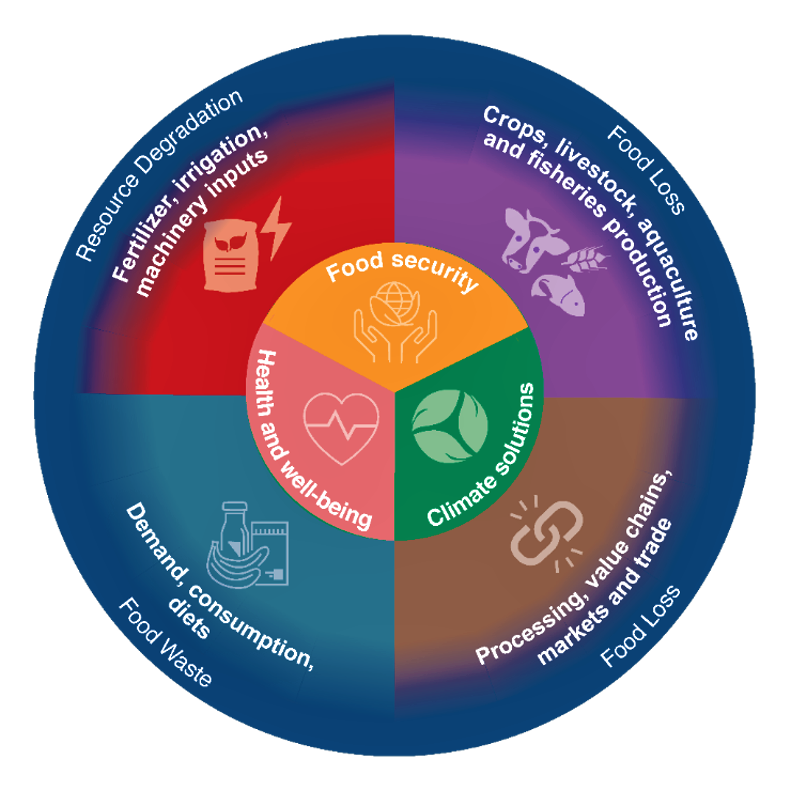
Food system components
Food system components, linkages, and outcomes

od system by establishing integrated production systems, broad-based genetic resources and balanced diets incorporating plant-based foods can reduce risks from climate change,” said Dr. Muru.

To respond to climate change via their food systems, countries can now move beyond supply-side mitigation in crop and livestock production, which has been the traditional approach, to encompass demand side strategies, mainly dietary changes.

Food system components, linkages, and outcomes
One answer to the climate crisis is on our plates. Plant-based diets reduce the amount of methane emissions, a powerful greenhouse gas released by ruminants. They also require less land, thus sparing areas that can be used to plant trees and store more carbon. When both these effects are combined, the maximum amount of greenhouse gas reduction achievable through dietary change is up to 8 billion tons of CO2e per year, say the authors (total anthropogenic emissions are currently about 52 billion tons per year).

Healthy and low-emission diets that are primarily plant-based can also reduce the burden of key non-communicable diseases, such as heart disease and diabetes, say the authors.

Access the paper, here: https://www.nature.com/articles/s43016-020-0031-z

Filed Under: Featured Story, Uncategorized, Yap Extension, Yap Research

Ecologically integrated and well managed hot composting system for recycling of organic matter

July 8, 2013

KOSRAE, FSM. Dr. Virendra M. Verma, Researcher/Extension Specialist, Kosrae Agricultural Experiment Station.

Organic matters such as crop residues and animal manure were used for composting. Solid swine manure was separated from the piggery effluent by using a rundown screen and sun dried for two weeks. Dried solid manure was shredded along with the dried organic materials such as crop residues, and was used as brown material (carbon rich) for composting. All fresh and green organic materials were shredded while still fresh and were used as green material (nitrogen rich) for composting. Hot composting technique was implemented to convert the nutrient-rich crop residues and swine manure into valuable compost at the Kosrae Agricultural Experiment Station. A six inch layer at the bottom of the compost pile was filled with coconut husk for better air circulation. Green and brown materials were layered alternately and on each layer a half inch thick layer of finished compost, and fresh and healthy soil from the forest was added as an activator. Aerobic process was used for decomposition of organic matters. High microbial activities generated heat that was regulated and maintained within the required range of 140-158oF in the composting pile by appropriate air circulation and proper moisture maintenance during heating phase. The pile was turned once in a week and treated effluent from the piggery was sprayed to control and maintain appropriate temperature and moisture, respectively. The heating phase gradually changed into a cooling phase and decomposition occurred without much generation of heat, and temperature dropped slowly up to 86oF. At the end of decomposition, during the maturation phase, the temperature dropped 68-77oF and resulted in finished compost. This ecologically integrated and well managed system composted the crop residues, manure and spilled feed in less than 3 months.

composting
Top left to clockwise: Shredded green material for composting, shredded brown material for composting, green and brown layers in compost pile, and finished compost ready to use.

Filed Under: Kosrae Research, News from land grants, Uncategorized Tagged With: compost, Kosrae

Primary Sidebar

Visit our programs

  • College of the Micronesia - FSM & Land Grant Program
  • College of the Marshall Islands & Land Grant Program
  • Palau Community College & Land Grant Program

Most frequently used words in tags

agriculture banana Bangladeshi biochar Black pepper chicken Chuuk climate change collaboration compost container gardening crab entomology Extension food security fruits grafting Kosrae lime livestock mangroves Marshall Islands outer islands outreach Palau Pearl pest Pineapple Pohnpei publications root crops salt tolerant smart climate agriculture sustainable sweet potato taro tissue culture training typhoon urban gardening vegetables World food day Yap Yap Day youth

For college staff

  • For staff

Locations of Micronesia Land Grant

November 2022
M T W T F S S
« Feb    
 123456
78910111213
14151617181920
21222324252627
282930  

and more . . .

Pearl farm management and halfpearl seeding training in Pakin Atoll, Pohnpei State, February 5-7, 2104

KOLONIA, POHNPEI, FSM. Dr. Manoj R. Nair (1) and Justino Smith (2) (1) Director & Chief Scientist, COM Land Grant … [Read More...] about Pearl farm management and halfpearl seeding training in Pakin Atoll, Pohnpei State, February 5-7, 2104

http://www.micronesialandgrant.org/wp-admin/

Copyright © 2022 ·Lifestyle Pro · Genesis Framework by StudioPress · WordPress · Log in