• Skip to secondary menu
  • Skip to main content
  • Skip to primary sidebar

Micronesia Land Grant Program

Good things are happening!

  • Home
  • About Us
    • Welcome to our website
    • Administration
    • Board of Regents
    • College of the Marshall Islands & Land Grant Program
    • College of the Micronesia – FSM & Land Grant Program
    • Palau Community College & Land Grant Program
    • Micronesia Land Grant Locations Map
    • Frequently asked questions
    • Contact Us
  • Land Grant people
    • All Micronesia Land Grant People
    • Micronesia Land Grant Administration & Regional Projects People
    • College of Micronesia-FSM Land Grant Administration
    • COM-FSM Chuuk Campus People
    • COM-FSM Kosrae Campus People
    • COM-FSM Pohnpei Campus People
    • COM-FSM Yap Campus People
    • College of Marshall Islands People
    • Palau Community College people
  • Research
    • Marshall Islands Agricultural Research Station
    • College of Micronesia – FSM – Research
      • Chuuk Agricultural Experiment Station
      • Kosrae Agricultural Experiment Station
      • Pohnpei Agricultural Experiment Station
      • Yap Agricultural Experiment Station
    • Palau Agricultural Experiment Station
    • Special Research Projects
  • Extension
    • College of the Marshall Islands – Extension
    • College of Micronesia – FSM – Extension
      • Chuuk Cooperative Extension Service
      • Kosrae Cooperative Extension Service
      • Pohnpei Cooperative Extension Service
      • Yap Cooperative Extension Service
    • Palau Community College – Extension
  • Instruction
    • College of the Marshall Islands – Resident Instruction
    • College of Micronesia – FSM – Resident Instruction
    • Palau Community College – Resident Instruction
  • Publications
  • Links
  • Job openings

News from land grants

COM’s RMI Regent Minister Heine Visits Sea Cucumber Hatchery

June 19, 2016

KOLONIA, POHNPEI, FSM. Dr. Manoj R. Nair, Director & Chief Scientist, COM Land Grant Aquaculture Programs, Nett Point, Pohnpei, FSM.

College of Micronesia Land Grant Program (NIFA, USDA) (COMLG), Board of Regents Member & Minister of Education Republic of the Marshall Islands Mr. Wilbur Heine and College of Marshall Islands Dean of Land Grant Mr. Biuma Samson visited Pohnpei from June 5-7, 2016.

Left to Right OFA Administrator Mr. Casiano Shoniber, Dean CMI Land Grant Biuma Samson, RMI Ambassador to Washington DC Mr. Gerald Zackios,, Director and Chief Scientist COM Aquaculture , Dr. Manoj R. Nair , Minister of Education RMI and COM Board Member, Mr. Wilbur Heine in front of the COM Land Grant Nett Point Hatchery at Nett Point, Pohnpei State.
Left to Right OFA Administrator Mr. Casiano Shoniber, Dean CMI Land Grant Biuma Samson, RMI Ambassador to Washington DC Mr. Gerald Zackios, Director and Chief Scientist COM Aquaculture, Dr. Manoj R. Nair , Minister of Education RMI and COM Board Member, Mr. Wilbur Heine in front of the COM Land Grant Nett Point Hatchery at Nett Point, Pohnpei State.

The main purpose of the visit was to visit the COM Land Grant Aquaculture Program at the COM Land Grant Nett Point hatchery. The COM Land Grant hatchery at Nett Point is currently developing site specific aquaculture technologies for economic development of FSM and Palau. The main focus currently is on sea cucumber aquaculture. The targeted species is the commercially important sea cucumber species Holothuria scabra commonly called sandfish and locally called “Langon” in Pohnpeian language. The sea cucumber farming tehnology being developed and trialed is based on hatchery produced sea cucumber juveniles.

Minister Wilbur Heine wanted to actually see the work being undertaken hands on by the local staff under the supervision of Dr. Nair. Minister Wilbur Heine and Dean Biuma Sampson had discussions with Dr. Nair to explore the possibility of coming over and establishing a sea cucumber hatchery in Majuro at the CMI Arrak Campus aquaculture facility and train Marshallese staff at COM Land Grant Nett Point hatchery on sea cucumber. These staff are expected to run the hatchery in Majuro when finished and up and running.

During the visit at Nett Point, Minster Wilbur Heine and Dean Biuma Samson also had the opportunity to meet the new Adiminstrator of Pohnpei State Government Office of the Fisheries and Aquaculture (OFA) Mr. Casiano Shoniber. The Minister Wilbur Heine and Dean CMI Land Grant was accompanied by Former Secreteriat of Pacific Community (SPC) Northern Region Chief and the new Republic of the Marshall Islands Ambassador to Washington DC, Mr Gerald Zackios.

Filed Under: News from land grants, Pohnpei Research Tagged With: aquaculture, Pohnpei

Development of Salt tolerant giant swamp taro (Cyrtosperma merkusii (Hassk.) Schott) and soft taro (Colocasia esculenta (L.) Schott) through tissue culture

May 6, 2016

KOSRAE, FSM. Dr. Virendra M. Verma, Researcher and Extension Specialist, Kosrae Agricultural Experiment Station.

Salinity and drought still remain the major abiotic stresses that limit as well as pose a threat to agricultural production in many parts of the world including Micronesia. The research project entitled, “In Vitro Selection for Salt Tolerance in Taro,” focused on developing salt tolerant varieties of giant swamp taro (Cyrtosperma merkusii (Hassk.) Schott), and soft taro (Colocasia esculenta (L.) Schott). Approved by the United States Department of Agriculture, National Institute of Food and Agriculture (USDA-NIFA), this project incorporated both plant biotechnology and breeding methods for the selection, assessment, and development of salt tolerant taro varieties. The project director of this project, Dr. Virendra M. Verma, shared that since taro is grown in lowland swamp areas across Micronesia, the crop is especially vulnerable to damage from saltwater. Considering the traditional and cultural importance given to giant swamp taro and soft taro as the most important staple food crops in the Micronesia region, the availability of salt tolerant taro varieties through this research project, is of great significance.

Giant swamp taro and soft taro, members of the family Araceae, are ancient crops that are grown throughout the humid tropics for their edible corms, leaves and petioles as well as for traditional uses. Nutritionally, taro is rich in fiber, calcium, potassium, iron, vitamin A, vitamin B1, vitamin B2, and vitamin C. The corms of taro are superior to potatoes in nutritional value, containing a higher proportion of proteins, calcium and phosphorus. The vitamin B content in taro corms is equivalent to that of cabbage and twice that of potato. Taro also contains greater amounts of vitamin B-complex than whole milk. In corms, the main bulk starch is present in very fine grains which make them easily digestible. The corms can be boiled, roasted, fried as chips or cooked in curries. The young leaves and petioles of soft taro are also used as food and cooked like any other green vegetable. The cooked leaves of soft taro have the same nutritional value of spinach.

Salinity, an abiotic stress that combines elements of water deficiency and sodium toxicity resulting in lost crop yield and arable land, is among the most serious and widespread of agricultural problems on the Micronesian islands. Giant swamp taro and soft taro are among the most important staple food crops in the region. Cultivated for local consumption as well as for export, these crops contribute significantly to the regional socio-economic growth and provide livelihood to almost all island people. Considered as the crucial staple crops for ensuring food, nutritional, and economic security, taros are placed on high agricultural priority in the region. However, the limitations in availability of salt-tolerant germplasm, and disease-free and elite seedlings, are a major bottleneck in taro production. Therefore, the efforts to develop salt-tolerant plants are of immense importance to increase crop productivity. In recent years, tissue culture based in vitro selection has emerged as a feasible and cost-effective tool for developing and/or screening salt tolerant germplasm.

The research study undertaken in Dr. Verma’s project involved assessment and development of salt tolerance in giant swamp taro and soft taro through in vitro, greenhouse, and field selection of tissue-culture raised plants. To establish aseptic cultures of collected taro germplasm, various in vitro experiments were performed. Different concentrations of sodium chloride were used for in vitro selection of salt tolerant germplasm. This in vitro selected germplasm was further evaluated for salt tolerance in the greenhouse, and was finally field evaluated at eight sites in four replications. In vitro selected germplasm of salt tolerant taros performed very well at coastal sites. Results based on various physiological and morphological parameters collected during this research are presented in international conferences, and a manuscript is under preparation to be published in peer-reviewed and reputed scientific journals.

The cultivation of the developed salt tolerant taro varieties in the Micronesian region through this research project would not only lead to the successful production of taro but would also contribute for the food and nutritional security of the region, and thereby, play a critical role in the preservation of traditional socio-cultural life of the Micronesian people.

In vitro cultures of salt tolerant soft taro.
Salt tolerant soft taros in field for evaluation.


In vitro cultures of salt tolerant giant swamp taro.
Salt tolerant giant swamp taros in field for evaluation.

Filed Under: Kosrae Extension, Kosrae Research, News from land grants Tagged With: Kosrae, taro, tissue culture

High efficiency micropropagation of pineapple for mass-scale elite seedling production

May 2, 2016

KOSRAE, FSM. Dr. Virendra M. Verma, Researcher and Extension Specialist, Kosrae Agricultural Experiment Station

Pineapple Micropropagation and Commercial Cultivation to Enhance Productivity in Micronesia, is a multi-state research project approved by the United States Department of Agriculture, National Institute of Food and Agriculture (USDA-NIFA) for the Micronesian region. The project director of this project, Dr. Virendra M. Verma, shared that this project focuses on enhancing pineapple production in the Federated States of Micronesia (FSM) and the Republic of the Marshall Islands (RMI) because non-availability of disease-free and elite seedlings, shortage of trained agricultural professionals, and limited acquaintance of farmers with commercial cultivation techniques have significantly restricted pineapple production in the Micronesian region. The ultimate aim of this project is to create opportunities of income generation for local farmers through providing a means of sustainable commercial pineapple cultivation, and thereby, improve food self-sufficiency, and nutritional security in the Micronesian region.

This project is of great significance as it is specifically designed to optimize micropropagation protocol and nursery management systems to produce elite and disease-free pineapple seedlings in bulk quantities in the Micronesian region. The project utilized biotechnological techniques for micropropagation and greenhouse acclimatization of tissue-cultured plants. The project activities also include educating local farmers in sustainable agriculture practices, and providing appropriate recommendations and training for commercial pineapple production.

The pineapple (Ananas comosus L. Merrill), a tropical plant with edible multiple fruit consisting of coalesced berries, is the most economically significant plant in the Bromeliaceae family. The project involved undertaking a research study to develop an economically feasible, efficient, rapid and reproducible multiplication protocol for two local commercially important pineapple cultivars (Ananas comosus cv. Kosraean and Ananas comosus cv. Hawaiian). A highly efficient in vitro multiplication method for both cultivars was developed by using apical and lateral meristems. Murashige and Skoog, 1962 medium (MS) was used throughout the study. The cultures were initiated on MS medium augmented with various combinations and concentrations of 6-benzylaminopurine (BAP) and 1-naphthaleneacetic acid (NAA). The medium augmented with 4.5µM BAP and 2µM NAA proved best for culture establishment. For further growth and subsequent multiplication, established cultures were first transferred on MS medium augmented with 9µM BAP and 3.5µM NAA, and later on the MS medium without any growth regulators. The number of multiple shoots produced from each explant after two subcultures varied from 18 to 35. A 16-h photoperiod with a temperature of 25oC day and night, light intensity of 80µmol m-2 s-1, and 60% relative humidity were maintained for multiplication. Many micropropagated shoots formed roots while they were still on the multiplication medium. However, maximum rooting was observed on MS medium augmented with 0.5µM NAA and 0.5µM BAP. Rooted plants were transferred to soil: compost (10:1, v/v) mixture in pots and acclimatized with 93% survival rate. Hundreds of fully acclimatized, tissue-culture produced pineapple plants are ready to be planted in the field.

Successful implementation of this project has resulted in the development of a high efficiency micropropagation method for mass production of elite, diseases-free seedlings, and acclimatization of hundreds of tissue-culture raised plants of selected pineapple varieties through appropriate nursery management systems. Preparation has been started for designing, implementing and conducting research trials for commercial pineapple cultivation at multiple sites as well as for collecting data for analysis, and the development and publication of a commercial pineapple cultivation guide to specifically suit the needs of local farmers. Recommendations will be provided for sustainable pineapple production through training workshops, hands-on trainings, farm visits, and field days. Three pilot sites in the Micronesian region, specifically in the Federated States of Micronesia (FSM) and Republic of Marshall Islands (RMI) will be developed as demonstration sites to carry out research, extension, and education activities of the project to encourage and promote sustainable commercial pineapple production among local farmers in the region.

Acclimatization of pineapple plantlets in greenhouse
Acclimatization of pineapple plantlets in greenhouse.
Acclimatized pineapple plants in nursery.


Acclimatized pineapple plants ready for field transfer.


Filed Under: Kosrae Research, News from land grants Tagged With: Kosrae, Pineapple, tissue culture

Yap CRE Researcher conferred with prestigious fellowship

April 3, 2016

Pohnpei, FSM. Jim Currie, Vice President, Cooperative Research and Extension, College of Micronesia-FSM.

Dr. Muru receives a momento from Dr. Kirti Singh, Chairman, World Noni Research Foundation.

Dr. Murukesan Krishnapillai, Researcher/Extension Specialist, Cooperative Research and Extension at Yap Campus has been bestowed with the Fellowship of the International Society for Noni Science for his outstanding contributions to Noni research and science during its Annual General Body Meeting held in conjunction with the 2nd World Noni Congress at S.R.M. University in Chennai, India on 19th March 2016. Established in 2010, the International Society for Noni Science promotes research, education and development of Noni all over the world. It may be recalled that Dr. Muru pioneered the research and extension work on Noni in Yap since 2006. Between 2006 and 2011, using Smith-Lever Funds Dr. Muru carried out an extension project on noni wherein he successfully trained a group of Yapese farmers in noni production, processing and marketing. Under a Hatch Project, he also scientifically validated the potency of noni varieties in Yap.

certificate-260
The certificate given to Dr Muru for his work with none.

During the 2nd World Noni Congress Dr. Muru presented a paper on ‘Noni-based agroforestry systems as an adaptive strategy in a changing climate’ that has also been adjudged for award of best oral presentation in the technical session on Crop Management. This paper will be published in the upcoming edition of the International Journal of Noni Research.


Cover image caption: Dr. Muru receives award from Dr. Kirti Singh Chairman, World Noni Research Foundation (from L to R - Prof. P.I. Peter, Chairman, Noni Biotech, Dr. Muru, Dr. Kirti Singh, Chairman World Noni Research Foundation, Dr. P. Rethinam, Editor, International Journal of Noni Research).

Filed Under: News from land grants, Yap Research Tagged With: Yap

Cooperative Research and Extension, COM-FSM Yap Campus participated in the 2016 Yap Day celebrations

March 13, 2016

YAP, FSM. Dr. Murukesan Krishnapillai, Researcher/Extension Specialist

COM-FSM Yap Cooperative Research and Extension (CRE) staff and Agriculture students participated in the 48th Annual Yap celebrations held at Makiy, between February 29 and March 1, 2016.

Yap Day is the biggest cultural celebration in Yap. This annual two-day event is accompanied with various cultural performances including traditional dances, traditional attire displays, stories, tattoo displays, stone money carrying, log pulling, cultural education activities, besides various stalls displaying a variety of traditional handicrafts and food items.

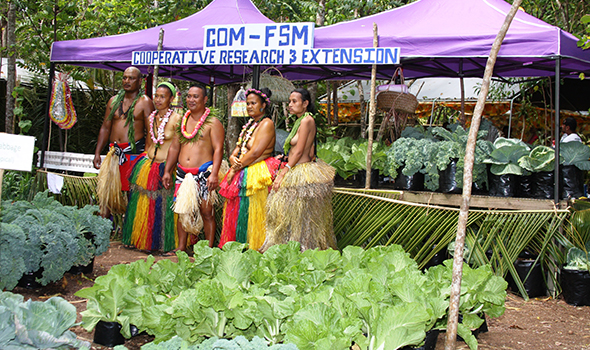
Yap CRE participated in the event and displayed family farming and urban gardening models, and low-cost food production systems. As it is customary, students and staff at the booth were dressed in traditional attire and promoted the importance of various local farm produce. A variety of vegetables from the CRE demonstration gardens and USDA-OAO OASDVFR Program clients were on display and sale. This includes kale, lettuce, Chinese cabbage, spinach, head cabbage, celery, bell pepper, spring onion and seedlings of eggplant, papaya, tomatoes and cucumbers. Backyard poultry farming is one of the priority areas of Yap CRE program and locally produced eggs from USDA-OAO OASDVFR Program clients’ farms were also on sale through this booth. Staff and students at the booth did their very best to give needed information to plant healthy vegetables at home and in the community.

The variety of leafy vegetables and the many growing systems on display received acclaim from many off-island visitors. Yap CRE is an active promoter of integrated family farming for food and nutrition security. Family farming is a way of life with a future and is the best way to ensure islands’ food security. It guarantees food in a sustainable manner while taking care of islands’ environment and respecting traditions and cultures. Please enjoy some images from the event!

CRE staff pose in front of the booth 590-350

CRE staff pose in front of the booth.

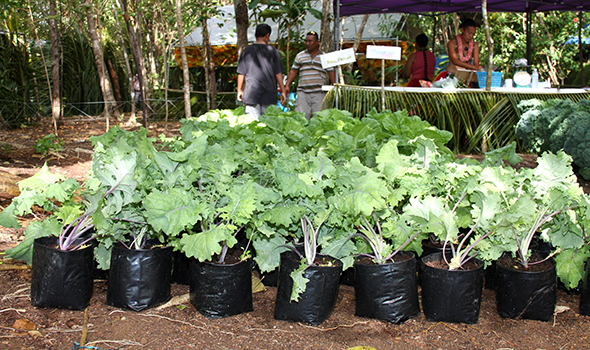
Blue kale in polybags_1 590-350

Chinese cabbage in grow box.

Chinese cabbage in grow box 590-350

Chinese cabbage in grow box.

CRE booth 590-350

YAP CRE booth.

Cucumber plant in growbag with stand-alone trellis 400

Cucumber plant in growbag with stand-alone trellis.

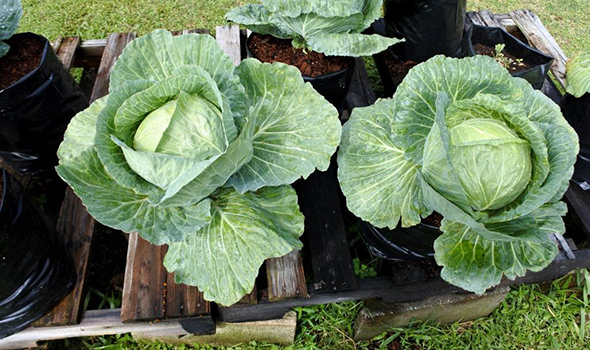
Head cabbages in polybags_1 590-350

Head cabbage in polybags.

A view of garden produce from a youth group 590-350

A view of garden produce from a youth group.

Product of Yap-Eggs from OASDVFR Program clients backyard poultry farms 590-350

Locally-grown eggs.

Purple kale in polybags 590-350

Blue kale in polybags.

Tim Bigelow, a successful poultry farmer (right) and OASDVFR Program Client discusses with Steven Young Uhk, CRE Coordinator (left) 590-350

Tim Bigelow, a successful poultry farmer (right) and OASDVFR Program Client discusses with Steven Young Uhk, CRE Coordinator (left).

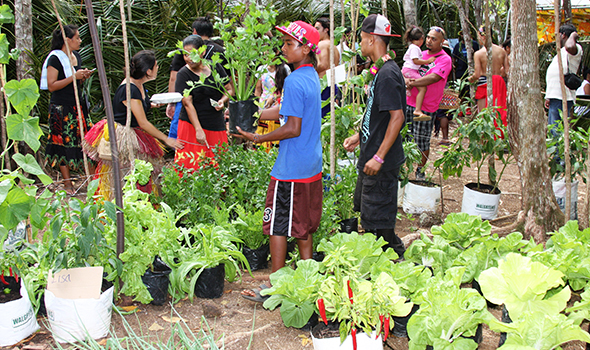
Veggies from OASDVFR Program clients gardens 590-350

Veggies from OASDVFR Program clients gardens

Filed Under: News from land grants, Yap Extension, Yap Research Tagged With: vegetables, World food day, Yap

  • « Go to Previous Page
  • Go to page 1
  • Go to page 2
  • Go to page 3
  • Go to page 4
  • Go to page 5
  • Interim pages omitted …
  • Go to page 9
  • Go to Next Page »

Primary Sidebar

Visit our programs

  • College of the Micronesia - FSM & Land Grant Program
  • College of the Marshall Islands & Land Grant Program
  • Palau Community College & Land Grant Program

Most frequently used words in tags

agriculture banana Bangladeshi biochar Black pepper chicken Chuuk climate change collaboration compost container gardening crab entomology Extension food security fruits grafting Kosrae lime livestock mangroves Marshall Islands outer islands outreach Palau Pearl pest Pineapple Pohnpei publications root crops salt tolerant smart climate agriculture sustainable sweet potato taro tissue culture training typhoon urban gardening vegetables World food day Yap Yap Day youth

For college staff

  • For staff

Locations of Micronesia Land Grant

November 2022
M T W T F S S
« Feb    
 123456
78910111213
14151617181920
21222324252627
282930  

and more . . .

Pearl farm management and halfpearl seeding training in Pakin Atoll, Pohnpei State, February 5-7, 2104

KOLONIA, POHNPEI, FSM. Dr. Manoj R. Nair (1) and Justino Smith (2) (1) Director & Chief Scientist, COM Land Grant … [Read More...] about Pearl farm management and halfpearl seeding training in Pakin Atoll, Pohnpei State, February 5-7, 2104

http://www.micronesialandgrant.org/wp-admin/

Copyright © 2022 ·Lifestyle Pro · Genesis Framework by StudioPress · WordPress · Log in