KOSRAE, FSM. Dr. Virendra M. Verma, Researcher and Extension Specialist, Kosrae Agricultural Experiment Station.
In Vitro Selection for Salt Tolerance in Taro
Dr. Verma is Project Director of research project on In Vitro Selection for Salt Tolerance in Taro. Salinity, an abiotic stress that combines elements of water deficiency and sodium toxicity is among the most serious and widespread of agricultural problems on islands resulting in lost crop yield and arable land. Therefore, the efforts to develop salt-tolerant plants are of immense importance to increase crop productivity. In recent years, tissue culture based in vitro selection has emerged as a feasible and cost-effective tool for developing salt tolerant plants. Taro is one of the most important staple food crops in the Pacific Region for local consumption as well as for export. The crop contributes significantly to the socio-economics and provide livelihood to almost all island people and thus is crucial for ensuring nutritional and economic security.
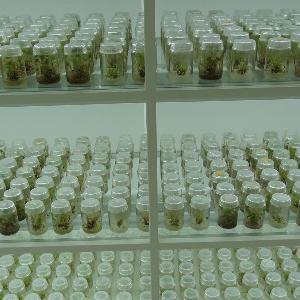
In vitro selected salt tolerant taro plantlets with well-developed roots were acclimatized before transfer to the field. For acclimatization, the plantlets were transferred into pots containing sterile potting mix to avoid contamination and were kept in the greenhouse for subsequent 2-3 weeks. Acclimatized plants were then transferred to the nursery for maintenance. Fully acclimatized taro plants were evaluated for salt tolerance level in the field using randomized complete block design having 2’ distance between plants and 3’ between rows, ten plants per replication and six replications at two sites (coastal and inland) with susceptible local check in-between. Some plants of taro performed very well at coastal sites. In vitro conservation of selected salt tolerant taro germplasm for mass multiplication in future has been started.
Participants’ knowledge and skills about in vitro and in vivo selection techniques have been increased through collection and review of related literature, in vitro experimentation and conservation, establishment of nursery management system, development of high efficiency multiplication protocols, and production of elite seedlings.
Field days were organized at evaluation sites and participants from various municipalities attended and participated in the field days. The participants included enthusiastic small-scale farmers, producers, agriculture students, youths, extension agents, state government agricultural staff and agricultural professionals. During the field days, technical assistance and support were provided. Participants were encouraged to ask questions and appropriate answers were provided. All the participants showed great interest in the project and expressed willingness to participate in future training workshops.
Multi-color cultivation guide on taro has been developed, printed and distributed to all interested farmers.
In Vitro Selection for Salt Tolerance in Sweet Potato
KOSRAE, FSM. Dr. Virendra M. Verma, Researcher and Extension Specialist, Kosrae Agricultural Experiment Station. Dr. Verma is Project Director of research project on In Vitro Selection for Salt Tolerance in Sweet Potato. Salinity, an abiotic stress that combines elements of water deficiency and sodium toxicity is among the most serious and widespread of agricultural problems on islands resulting in lost crop yield and arable land. Therefore, the efforts to develop salt-tolerant plants are of immense importance to increase crop productivity. In recent years, tissue culture based in vitro selection has emerged as a feasible and cost-effective tool for developing salt tolerant plants. Sweet potato is one of the most important staple food crops in the Pacific Region for local consumption as well as for export. It contributes significantly to the socio-economics and provides livelihood to almost all island people and thus is crucial for ensuring nutritional and economic security.
Germplasm of different varieties of sweet potato collected from the Micronesia Region, have been planted and maintained in the greenhouse. Shoot apices were isolated from all varieties and inoculated on media to establish cultures. All varieties were established in vitro and maintained for further experiments. Different types of media were formulated by using various combinations of plant growth regulators along with other media components like organic and inorganic nutrients/minerals, vitamins and amino acids to develop suitable and efficient multiplication and maintenance protocols for all varieties. In vitro screening to study salt tolerance level in collected and tissue culture maintained germplasm of sweet potato has been started. Media formulation and preparation for in vitro screening for stress tolerance are under progress for sweet potato cultures. In vitro selected and acclimatized salt tolerant sweet potato plantlets will be further screened in the greenhouse and field.
Participants’ knowledge and skills about in vitro selection techniques have been increased through collection and review of related literature, in vitro experimentation, and development of high efficiency multiplication protocols.
Multi-color cultivation guide on sweet potato has been developed, printed and distributed to all interested farmers.